For your own sake, stop working so hard
Americans work more hours and take less days off than people around the world. Furthermore, the productivity of the American worker has increased fourfold since the 1950s even as buying power of wages has not. During this time of economic troubles, it may seem counter-intuitive to advocate working less. But these economic troubles are not due to low productivity or corporate profitability, but rather corporate greed. The American corporate culture focused on profits is unsustainable and destructive to the long-term health of the economy (not to mention the health of the workers). Shorter workweeks would spread out the workload and give jobs to the unemployed, give Americans more leisure and family time, and even help to lower America's energy consumption.
I think that the idea of people being *too* hardworking is certainly revelation to my life, as well as the lives of most people I know. I am especially interested in the cultural differences regarding work between America and other countries, and I think it would be interesting to research more on that aspect. For example, I know that in Europe taking afternoon siestas is common, and I think it would be interesting to research to benefits of siestas on overall health and well being.
Sunday, January 29, 2012

Sunday, January 22, 2012
Monday Matters- Marking Period 4 Week 1
The Other Final Frontier
By BEN HELLWARTH
While missions to outer-space and the moon bear technological and scientific fruits, they without a doubt expensive: coming billion dollar price tags. Today's economic downturn and high government debt does not mean that we should stop pursuing scientific expansion entirely, however, but that the United States should look for better value projects than space exploration. And an area with a lot of potential for that is exploration in the other direction: in the deep ocean. American underseas programs have been limited and then dwindling as the Navy shelved most of what programs there were due to some dangers as well as not high enough suitability for military endeavors. There is much opportunity in the ocean's depths, however, for advancements in medicine, biology, and environmental understanding that is ample reason to expand exploration into "The Other Frontier".
This article shed a lot of light for me on the possibilities for science on own home planet, and I think that today innovative research is more important than ever. It would be interesting to research more on possibilities for research like this one, as well as addressing questions of government and military involvement in science.
Sunday, January 8, 2012
Monday Matters -Nicholas D. Kristof Synthesis
Kristof overall, has liberal views in politics, but is not afraid to criticize whichever side, and as a humanitarian cares strongly about international politics as much as domestic politics. He moves beyond international competitiveness and even commends China above America, as in his article A New Kim, A New Chance? saying "American officials blame China for coddling North Korea, but at least Beijing has a strategy", but his reason for commending China(in helping dissolve North Korea) shows that he believes in democracy and human rights above all. In President as Piñata, and Waiting for Mitt the Moderate, Kristof shows that although he is clearly a liberal Democrat, he is not afraid to cross party lines for the good of America, admitting in the latter "but the Democratic claims of constant inconstancy seem exaggerated". He argues that "If we turn Obama out of office a year from now, let’s make sure it is because the Republican nominee is preferable, not just out of grumpiness toward the incumbent during a difficult time", showing that he does not agree with excessive critcism of Obama, nor does he dismiss the possibility of choosing a Republican entirely.
Sunday, December 11, 2011
Monday Matters-Marking Period 3 Week 2
President As Piñata
Kristof's position overall is sympathy towards President Obama and disappointment towards the left-wings who have overall blamed him for the bad economy. He starts by saying pointing out that it's still"A YEAR before President Obama faces re-election", using the capitol letters to point out the ridiculousness that people are acting like the election is so soon. Before talking about Obama's accomplishments, he starts out with a concession saying, "Like many, I have disappointments with Obama. He badly underestimated the length of this economic crisis, and for a man with a spectacular gift at public speaking, he has been surprisingly inept at communicating", which gives him credibility as a realistic observer, and not just a blind supporter of Obama. By making the comparison of Obama to a piñata, Kristof establishes that he has become a scapegoat for the economy that was not all his fault, and opens him up to sympathy, as an appeal to not vote based on "grumpiness toward the incumbent during a difficult time".
Kristof's position overall is sympathy towards President Obama and disappointment towards the left-wings who have overall blamed him for the bad economy. He starts by saying pointing out that it's still"A YEAR before President Obama faces re-election", using the capitol letters to point out the ridiculousness that people are acting like the election is so soon. Before talking about Obama's accomplishments, he starts out with a concession saying, "Like many, I have disappointments with Obama. He badly underestimated the length of this economic crisis, and for a man with a spectacular gift at public speaking, he has been surprisingly inept at communicating", which gives him credibility as a realistic observer, and not just a blind supporter of Obama. By making the comparison of Obama to a piñata, Kristof establishes that he has become a scapegoat for the economy that was not all his fault, and opens him up to sympathy, as an appeal to not vote based on "grumpiness toward the incumbent during a difficult time".
Saturday, November 26, 2011
Monday Matters- Marking Period 3 Week 1
Are We Getting Nicer? By Nicolas D. Kristof
Even though to many right now it may seem like the world is in chaos, when you look at are time from a historical context, we have made a lot of progress in "human decency"at least. There is less discrimination based on sex and race, and less violence (in war or otherwise). Either though civilian deaths and genocide still happen, now there is a general acknowledgment that it is wrong, as opposed to when it was just a fact of war. The reasons for this moral progress may include growing sympathy and education and declining chauvinism.
Even though to many right now it may seem like the world is in chaos, when you look at are time from a historical context, we have made a lot of progress in "human decency"at least. There is less discrimination based on sex and race, and less violence (in war or otherwise). Either though civilian deaths and genocide still happen, now there is a general acknowledgment that it is wrong, as opposed to when it was just a fact of war. The reasons for this moral progress may include growing sympathy and education and declining chauvinism.
Sunday, November 6, 2011
Monday Matters- Marking Period 2, Week 5 Synthesis
Before, I did research on the case of Anwar al-Awlaki, I wasn't really sure about my opinion, and though the process of reading different viewpoints, I found that I could sympathize with both sides. I think that anti-terrorism measures are necessary, but I'm not sure to what extent they justify acts that may break with America's founding ideals. Anwar al-Awlaki's death as an American citizen is unfortunate, and I think that it would have been better if he got his right of due process, but I don't think that we can retrospectively judge events that are ambiguous in details, nor should we too harshly criticize the Obama administration for measures of national security. However, action needs to be taken, to more precisely define the exact powers that the executive branch has in these kinds of situations, so that something like this doesn't happen again. I do believe that there are circumstances that justify killing an American citizen, however in Anwar al-Awlaki's case I'm not sure whether that it was justified or not. Carefulness, thought, and time must however be put into these delicate decisions. However, in the case of Anwar al-Awlaki's son Abdulrahman al-Awlaki, I am more sure that his death was wrong (despite his proximity to more justifiable targets). Nothing justifies the drone-strike killing of a 16 year-old, much less a 16 year-old American citizen, and I am dismayed that there has been much less press concerning Abdulrahman al-Awlaki's death, and the lack of an official response from the Obama administration concerning this tragedy.
Monday Matters-Marking Period 2 Week 5, Visual(s)

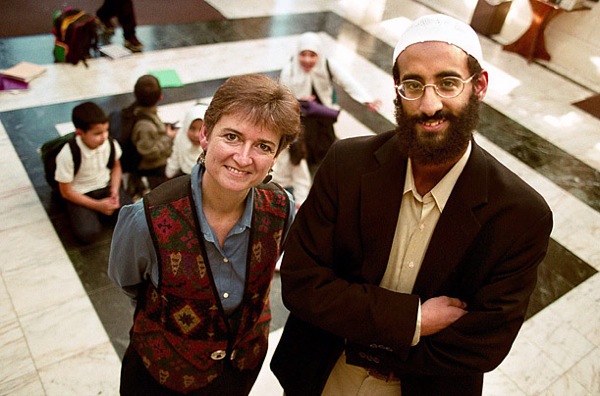
http://photos.denverpost.com/mediacenter/2011/09/photos-anwar-al-awlaki-killed-in-yeman/#name%20here
These images of Anwar al-Awlaki are as contradictory as accounts of his history. In one he is smiling;in the other his mouth is open in commanding speech. In one he is posed next to a white, non-Muslim women; in the other he is alone. In one his arms are relaxed and crossed; in the other his hand is strikingly pointed in a deliberate act of nonverbal communication. In the second picture al-Awlaki is a banner for Muslim/non-Muslim friendly relations; in the first he is a rallying call for jihad. The first picture is absent of a recognizable background, rather his fence-like surrounding seems manufactured for the cause of not distracting from his video, while in the second Muslim children can been seem behind al-Awlaki and Patricia Morris, symbols of innocence and purity that contrast the violence he is calling for in the first. In both pictures, al-Awlaki's clothing contrasts with the background, however the colors of black and white are flipped, symbolizing the change that has occurred in him from the time of the second picture to the first one.
Subscribe to:
Posts (Atom)